The investigation was dropped, you were acquitted, or you were only a witness. Even so, data often remains in police systems for years: case records, criminal files, photographs, fingerprints. None of this appears on a certificate of good conduct. It does, however, show up whenever you have contact with the police again, and it can be queried in reliability checks. We request information on what is stored about you and enforce its deletion.
Police data is not the criminal record
The Federal Central Register (Bundeszentralregister), kept by the Federal Office of Justice, contains convictions; information from it is issued as a certificate of good conduct (Führungszeugnis). The police keep their own, separate records. These also include proceedings that never led to a conviction, and people who were recorded only as witnesses, victims or companions. A clean certificate therefore tells you nothing about what the police hold on you. The Bonn police headquarters makes this point expressly in its replies.
When an application makes sense
An application is worthwhile above all if an investigation was discontinued or ended in an acquittal, if your photograph and fingerprints were taken, if you appear in a case only as a witness or victim, or if an incident lies many years back.
Often a check is coming up. For a firearms licence, the authority obtains statements from the police and the state criminal police office (§ 5(5) no. 3 of the Weapons Act, WaffG). In reliability checks under the Aviation Security Act (LuftSiG), for example for staff at Cologne Bonn Airport, the aviation security authority makes enquiries with the police (§ 7(3) no. 2 LuftSiG) and may also take discontinued investigations into account (§ 7(1a) LuftSiG). If you are preparing for such a check, you should know beforehand what is on file.
Legal basis in North Rhine-Westphalia
Processing of data by the police is not governed by the GDPR (Art. 2(2)(d) GDPR) but by the NRW Police Act (PolG NRW) and Part 3 of the NRW Data Protection Act (DSG NRW). Two rights follow from this. Under § 49 DSG NRW you can ask whether and which data about you is processed, where it comes from, for what purpose, to whom it was disclosed and how long it is to be kept. Under § 32(1) PolG NRW in conjunction with §§ 50 and 54 DSG NRW, data must be deleted if storing it is unlawful or the police no longer need it for their tasks. This expressly applies where the suspicion of an offence has fallen away.
The review periods in § 22(2) PolG NRW are maximum periods. The police do not have to wait until a review date is reached; on application they must examine in the individual case whether continued storage is still necessary. After an acquittal, a refusal to open trial proceedings or a final discontinuance, storage is unlawful if the decision shows that you did not commit the offence or did not commit it unlawfully. Otherwise it is lawful only if specific facts support a prognosis of future offending, and the police must document that prognosis (§ 22(3) PolG NRW).
Photographs and fingerprints
Photographs, finger and palm prints are taken under § 81b of the Code of Criminal Procedure (StPO) or § 14 PolG NRW. Records made only for a particular criminal case have served their purpose once that case is over. Records kept for identification purposes may, according to the case law of the Federal Administrative Court, only be retained as long as there are concrete indications that they could assist future investigations. The decisive factors are the nature and seriousness of the earlier allegation, your personality and how long you have stayed out of trouble. If that prognosis is lacking, the records must be destroyed. How identification processing works, and when you can object to it in advance, is explained on our page on identification processing.
Where your data may be stored
An application to the local police headquarters covers only the data for which it is responsible. Other possible holders are the NRW State Criminal Police Office (Landeskriminalamt), the joint police information system at the Federal Criminal Police Office (Bundeskriminalamt), the Federal Police and the police forces of other German states. For data in the joint information system, the Federal Criminal Police Office answers requests in agreement with the authority that entered the data, and the same applies to deletion (§ 84 of the Federal Criminal Police Office Act, BKAG). We therefore first establish where you have come to police attention and then apply to every authority that may hold data. With the deletion request we also ask the police to notify the recipients to whom they passed data (§ 50(5) DSG NRW).
Data outside North Rhine-Westphalia and at the Federal Criminal Police Office
Many clients have lived in more than one German state or were recorded by the police elsewhere, for example after a check while travelling or in proceedings at a former place of residence. Each state has its own police and data protection legislation. The rights to information and deletion are similar everywhere, but time limits and responsibilities differ. For data from other states, the Bonn police headquarters expressly refers to the respective state criminal police office (Landeskriminalamt).
For the Federal Criminal Police Office (Bundeskriminalamt), the rights under the Federal Data Protection Act apply (§§ 57, 58 BDSG). For data in the joint police information system, into which all states enter data, the Federal Criminal Police Office answers requests in agreement with the authority that entered the data; the same applies to correction and deletion (§ 84(1) BKAG). We file applications in writing anywhere in Germany. You do not need to come to Bonn; the power of attorney and documents can be sent by post or email.
How we proceed
You sign a power of attorney and give us, as far as you know them, previous addresses, case numbers and decisions on discontinuance or acquittal. We submit a reasoned application for information, deletion and destruction of identification records. In the alternative we ask for a formal decision open to appeal, stating for each category of data what remains stored, on what legal basis and until when. Authorities must deal with such applications without undue delay (§ 51(2) DSG NRW). It still often takes several weeks, because the police have to make enquiries with several departments and obtain a statement for each case file.
If the police refuse deletion in whole or in part, we examine the reasons. A complaint to the NRW Commissioner for Data Protection and Freedom of Information and an action before the administrative court are then possible. For the Bonn police headquarters, the Administrative Court of Cologne (Verwaltungsgericht Köln) has jurisdiction.
If you are not a German citizen
For foreign nationals, stored police data can matter beyond criminal law, for example when authorities assess reliability or security questions in residence matters. Information requests and deletion applications are open to everyone, regardless of nationality or residence status. We correspond with the authorities in German and explain the replies to you in English. More on the interplay of criminal proceedings and residence law: visa and residence in criminal proceedings.
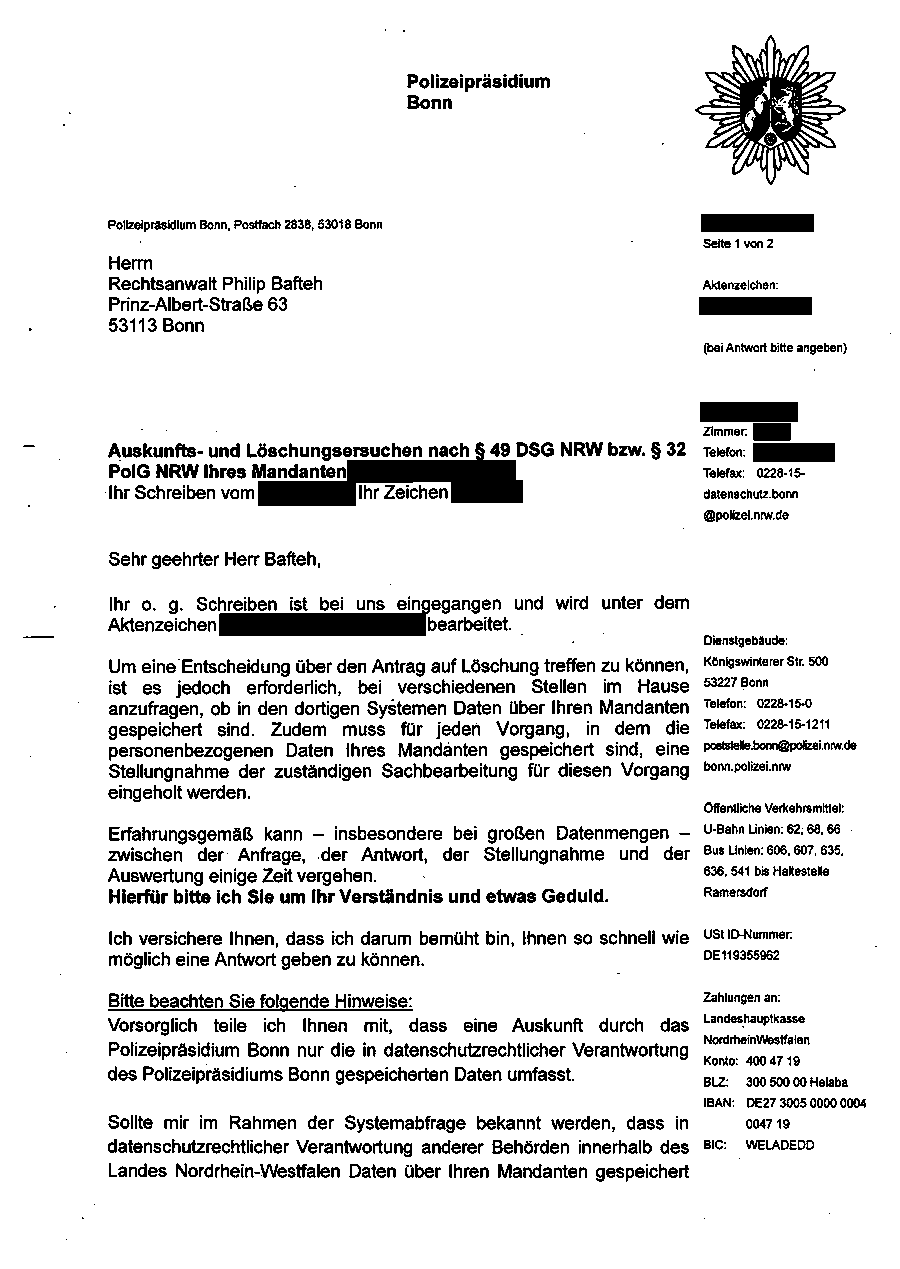
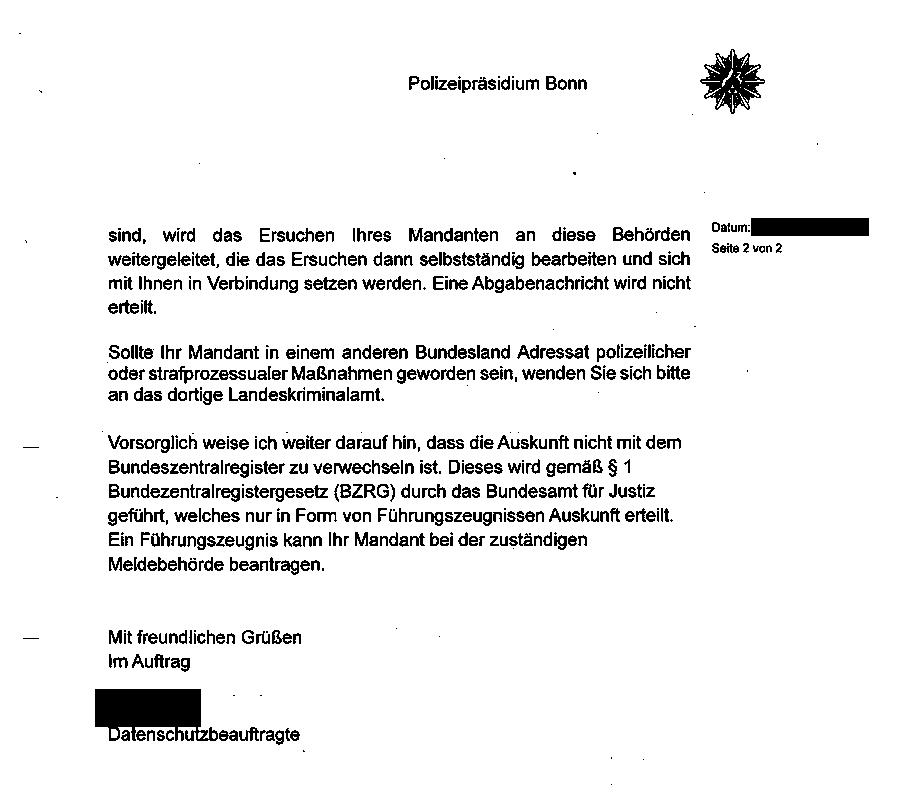
Example: reply from the Bonn police headquarters
This is the first reply to one of our applications. The police headquarters confirms receipt, makes internal enquiries with all departments that may hold data and obtains a statement from the case officer for each file. Data held by other authorities in NRW is passed on; for other German states it refers to the respective state criminal police office. We have blacked out personal and case-related details.
Frequently asked questions
Do I have to wait until the retention period has expired?
No. The periods in § 22(2) PolG NRW are maximum periods for review. On your application the police must check earlier whether the data is still needed.
Will my employer find out about the application?
No. The application is addressed only to the police authorities that process your data. No third parties are involved.
Is data held in other German states deleted as well?
Only if the application reaches the authorities there. Within NRW the police forward applications; for other states they refer you to the respective state criminal police office. We therefore apply specifically to every authority that may hold data.
What does a lawyer add to this application?
The police often answer an informal letter only for their own department and without detailed reasons. We draft the application so that the authority has to examine each category of data separately, justify any continued storage and, on request, issue a formal decision that can be challenged. We know which authorities besides the local police headquarters may hold data and apply to them in parallel. We check every reply to see whether the reasoning holds up. If the police base continued storage on a thin prognosis, we challenge it specifically, if necessary through the data protection supervisory authority or the administrative court. All correspondence runs through our office, not through your letterbox. We tell you the cost in advance.
Would you like to know what is stored about you? Get in touch or call +49 228 504 463 36. The first assessment by phone is free of charge for up to 10 minutes.
This page gives general information and does not replace advice on your individual case.